

Most iGaming website owners are making AEO mistakes at the strategy and architecture level, not the writing level. The six most common are: briefing for keywords instead of questions, accepting factually vague content, ignoring AEO-ready page structure, underestimating E-E-A-T, letting content go stale, and treating AEO and SEO as separate strategies. Each is fixable. None requires rebuilding your site from scratch.
Are iGaming Websites Actually Losing Visibility to Answer Engines?
Yes, and I found the pattern quite consistent after reviewing well over 1,900 casino and affiliate pages. Sites that invested heavily in traditional SEO are seeing their content bypassed by AI overviews that cite competitors instead. The reason isn’t domain authority or backlink profiles. It’s structural. The content isn’t written in a way that answer engines can efficiently extract and cite.
I explained the fundamentals of AEO for iGaming in my previous guide, but the structural execution is where I see most owners stumble
The AEO mistakes below are where that gap originates. All of them are owner-level decisions.
Mistake 1: Are You Briefing for Keywords or for Questions?
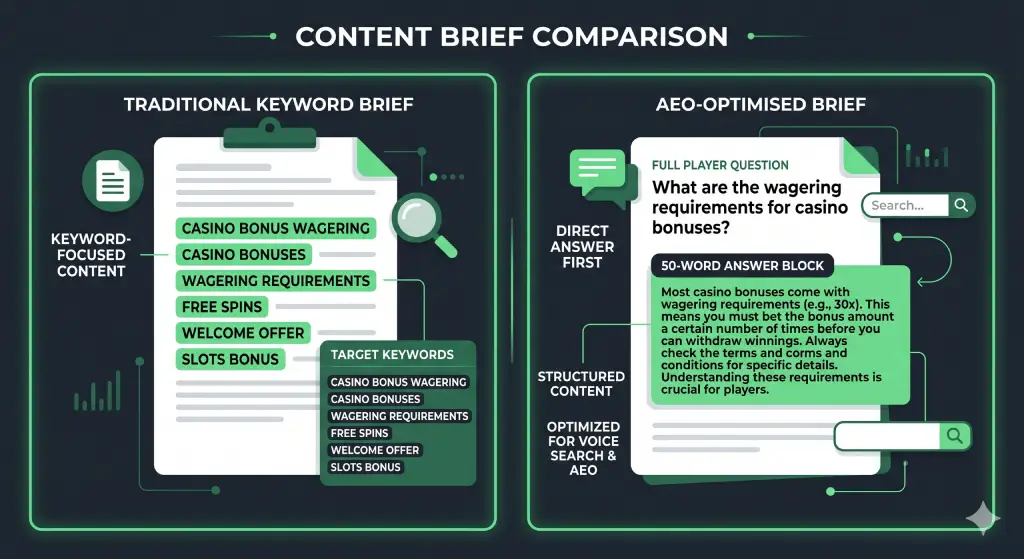
Site owners commissioning content are still largely briefing around keyword clusters. “Target: casino bonus wagering.” “Target: live roulette RTP.” That approach served well for a decade. It’s now only half the job.
Players increasingly phrase queries in full, natural language. “What does a 40x wagering requirement mean on a $200 bonus?” is how the question actually gets asked. A page titled “Casino Bonus Wagering” that never directly answers that question in its opening sentences is invisible to AEO, regardless of its keyword ranking.
The fix is a brief-level decision. Every content brief should identify the specific question the page must answer, and require that answer to appear within the first 40 to 60 words of each section.
Mistake 2: Are Your Bonus and RTP Explanations Specific Enough to Be Cited?
Describing a playthrough rate as “the number of times you must wager your bonus before withdrawing” is accurate. It’s also nearly useless as a cited answer.
An answer engine responding to “what does a 40x playthrough rate mean on a $200 bonus?” needs a concrete, numerical response: “$200 bonus at 40x means wagering $8,000 before withdrawal is permitted.” That is the citable answer. Vague definitions get skipped.
This applies across all iGaming content. Every RTP figure, every wagering rate, every KYC timeline estimate needs a specific number attached to it. Site owners need to enforce that standard at the approval stage, not after publication.
This is a core part of my writing and research process, ensuring every claim is verifiable before it hits the page.
Mistake 3: Does Your Page Structure Allow AI to Extract Clean Answers?
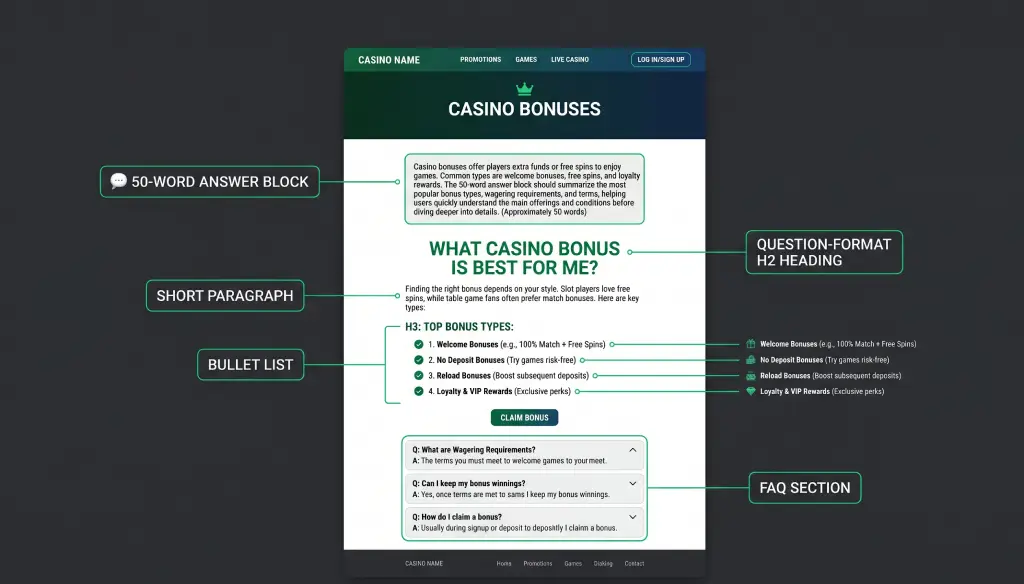
Answer engines extract self-contained answer units. A wall of copy, however well-written, is harder to cite than a short, focused paragraph that answers one question completely and makes sense in isolation.
The structural requirements for AEO-ready iGaming pages are:
- A direct 40 to 60-word answer opening each major section
- H2 and H3 headings phrased as real player questions, not keyword clusters
- Paragraphs of three to four sentences maximum
- Bulleted lists, numbered steps, and HTML tables wherever data allows
- A dedicated FAQ section with long-tail conversational queries answered in full, standalone sentences
FAQs are worth calling out specifically. For AEO in iGaming, the FAQ is one of the most valuable elements on the page, catching follow-up queries and providing additional citation opportunities. Site owners still treating FAQs as optional are leaving significant visibility unclaimed.
Mistake 4: Are Your E-E-A-T Signals Strong Enough for AI to Trust Your Content?
E-E-A-T (Experience, Expertise, Authoritativeness, Trustworthiness) isn’t a new concept, but its importance has increased specifically in the context of AEO. AI algorithms in 2026 are designed to avoid hallucinations by prioritising verified, human-authored sources. Content lacking clear authorship signals gets downweighted.
For iGaming site owners, the practical requirements break down like this:
- Experience: Content should reflect genuine familiarity with the product. A live casino review demonstrating actual play is weighted differently from one assembled by repurposing competitor pages.
- Expertise: Author biographies with verifiable credentials, links to LinkedIn profiles, and accurate technical terminology (RTP, KYC, wagering contribution percentages) all signal expertise to AI.
- Authoritativeness: Topical depth across a specific niche outperforms shallow coverage of many topics. A site with 80 accurate articles on live casino mechanics will be trusted over one with 500 articles across 50 gambling topics.
- Trustworthiness: Transparent authorship, accurate bonus terms, honest assessments rather than promotional copy, and a clearly accessible Contact page. In iGaming, this also means not overstating bonus values or misrepresenting licensing status.
Site owners publishing high-volume AI-generated copy without human expert review aren’t just risking content quality. They’re actively undermining their AEO eligibility.
Stop buying cheap, generic content if you want to maintain the topical authority that answer engines actually trust.
Mistake 5: How Often Are You Auditing Your Content for Accuracy?
Answer engines cross-reference claims. In iGaming, content goes stale quickly. RTP values are occasionally revised. Bonus terms change. Licensing status changes, and a casino losing its UKGC licence is not unusual in this space. KYC timelines shift as platforms update their verification infrastructure.
Content built two years ago and left untouched carries claims that may now be inaccurate. That’s a player trust problem, a potential compliance problem, and an iGaming AEO problem simultaneously. AI algorithms favour fresh data. AEO articles should carry a visible “last updated” line, and site owners should run content accuracy audits at least quarterly.
Mistake 6: Are You Running AEO and SEO as Separate Strategies?
This is the most strategically costly mistake. AEO is not a replacement for SEO, and it’s not a separate content stream. The highest-performing iGaming content in 2026 combines both, along with GEO (Generative Engine Optimisation), in a single hybrid page structure.
Sites using this iGaming content strategy hybrid are seeing a 3 to 5x increase in visibility, appearing in both traditional search results and AI overviews simultaneously. The model works like this:
- AEO layer: Direct 40 to 60-word answer at the top, question-format headings, structured FAQ
- SEO layer: Long-form narrative exceeding 1,000 words with expert analysis, original data, and genuine E-E-A-T depth
- GEO layer: HTML tables presenting hard specifications (RTP figures, bonus comparisons, licensing details) that AI can parse efficiently for comparison queries
If you focus on AEO alone, you’ll accumulate citations but generate limited traffic. If you focus on SEO alone, you’ll rank, but increasingly beneath an AI overview that doesn’t cite you. The hybrid covers both. If you need a custom content ecosystem built to these standards, I’ve found that starting with a technical audit is the most efficient path forward.
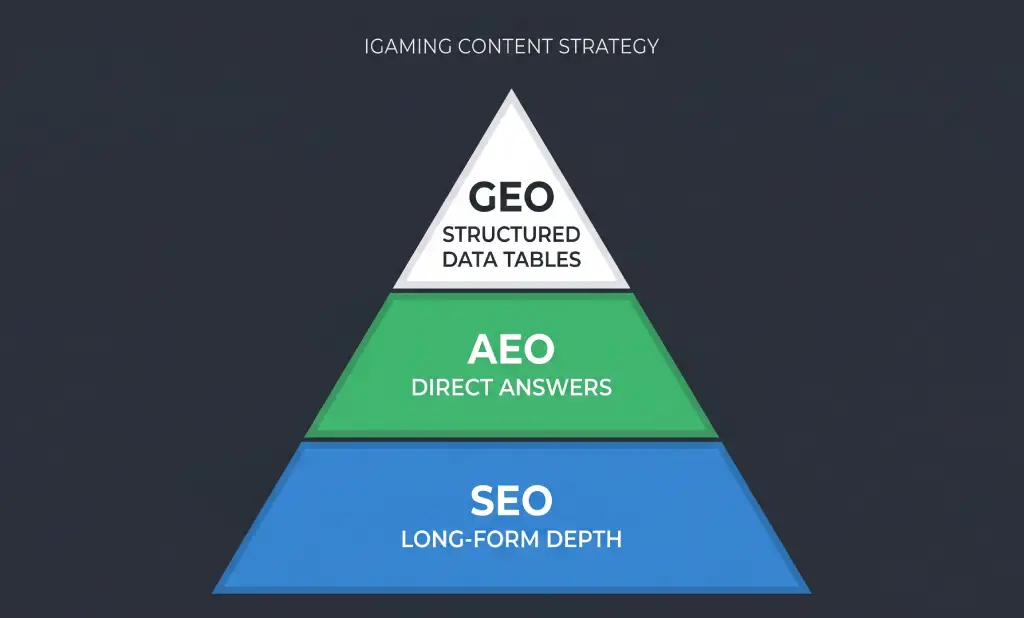
Section Image Alt Text: Three-layer pyramid diagram illustrating the AEO, SEO, and GEO hybrid content strategy for iGaming websites, with each layer representing a different optimisation goal.
How Does AEO Improve User Experience on iGaming Platforms?
This is a question I found site owners rarely ask, which is fairly telling. Most think about AEO purely as a visibility and citation strategy. The user experience dimension gets overlooked entirely.
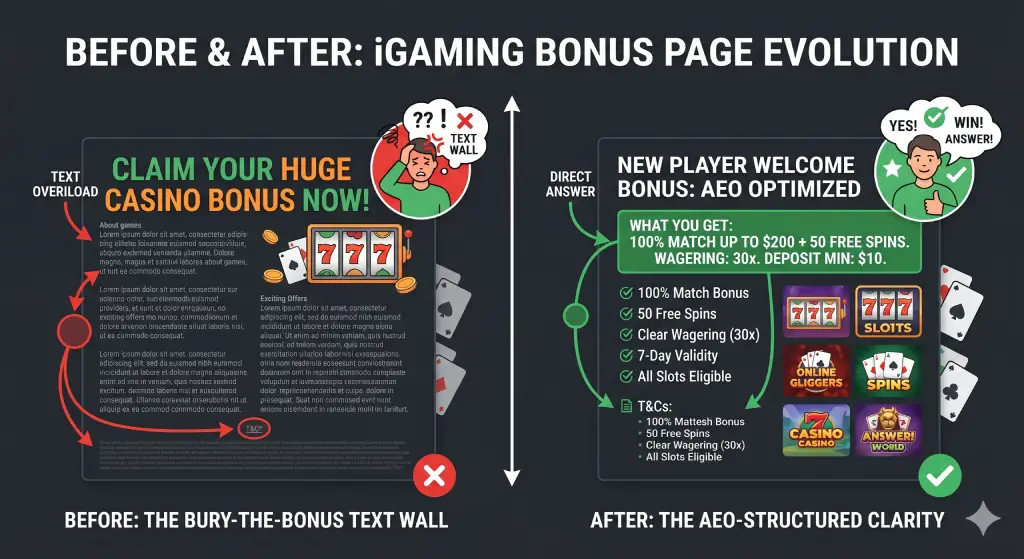
The connection is direct. AEO requires content that answers questions clearly, specifically, and immediately. That’s not just what answer engines prefer. It’s what players prefer too. A player landing on a bonus page and finding a plain-language explanation of the wagering requirement within the first two sentences has a meaningfully better experience than one who has to scroll through four paragraphs of promotional copy to find the same information.
I found that iGaming pages built to AEO standards consistently perform better on the metrics that reflect genuine user experience:
- Lower bounce rates: Players who get their question answered immediately are more likely to stay and explore. Pages that bury answers see higher exits.
- Higher time-on-page for engaged users: Structured content with clear headings allows players to navigate directly to the section relevant to them, which increases the quality of time spent on the page.
- Fewer support queries: When KYC requirements, withdrawal timelines, and bonus conditions are explained with specific figures upfront, players arrive at the process better informed. That reduces friction and support volume.
- Stronger trust signals: A page that answers honestly and specifically, including limitations like game exclusions from wagering contribution or maximum bet rules during bonus play, builds more player trust than one that leads with promotional claims and hides the conditions.
AEO-optimised content and player-friendly content are, in practice, the same thing. Site owners who build for answer engines are also, almost as a side effect, building a better experience for the players who do click through.
How Can AEO Strategies Increase Player Engagement in Online Casinos?
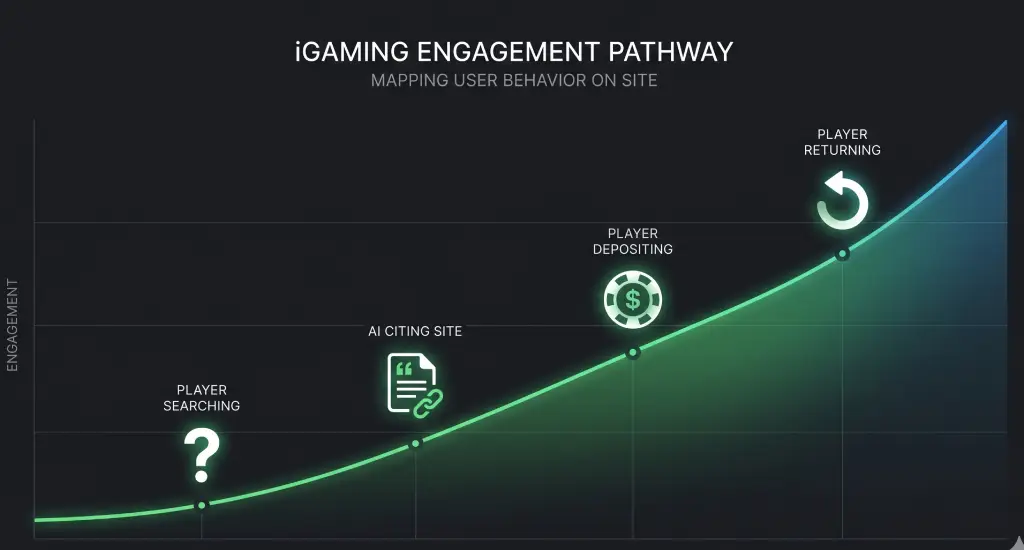
Player engagement in iGaming is typically measured in session depth, return visit rate, and conversion from information-seeking behaviour to active play. I found that AEO-structured content influences all three, though not always in the ways site owners expect.
The mechanism works like this. A player who finds clear, accurate answers to their questions on your site, whether through an AI citation or a direct visit, develops a baseline level of trust in your brand. That trust is the foundation of engagement. A player who feels informed is a player who feels comfortable enough to deposit, to explore game categories, and to return.
The specific AEO elements that drive engagement in iGaming are:
- FAQ sections targeting real player concerns: Questions like “Can I withdraw my bonus winnings before clearing the wagering requirement?” or “Which games contribute 100% to playthrough?” are high-anxiety queries. Answering them directly and honestly on your site reduces the hesitation that kills conversions.
- Structured game and bonus comparison tables: Players comparing options engage more deeply with pages that present data clearly. An HTML table showing RTP figures across five live roulette variants keeps a player on your page longer and positions your site as a reliable reference point.
- Accurate responsible gambling content: Players who see clear, accessible information about deposit limits, self-exclusion, and cooling-off periods are more likely to trust the platform enough to engage with it long-term. This isn’t unusual, and it’s a point many operators underestimate.
- Topical depth across related queries: A site that answers the initial question and then links naturally to related content (from “what is RTP?” to “which slots have the highest RTP?” to “how does volatility affect RTP?”) keeps players engaged in an information journey that builds brand familiarity over multiple sessions.
The underlying point is a fairly simple one. Engaged players are informed players. AEO strategies that prioritise answer clarity, factual specificity, and honest content are the same strategies that build the trust and familiarity that drive long-term player engagement. The two goals are not in tension. They are the same goal approached from different angles.
Expert’s Verdict
Every AEO mistake on this list originates at the ownership and strategy level. The brief templates, structural standards, approval criteria, and audit schedules are all decisions site owners control directly.
The iGaming sites that adapt earliest will earn cited authority across the questions players ask most. RTP accuracy, bonus mechanics, licensing status, KYC processes: these are high-intent, precisely queried topics that answer engines are built to surface. The sites structured to answer them clearly will be the ones cited.
The sites that aren’t adapting their iGaming content strategy to AEO? That gap is closing faster than most people in this space seem to realise.
Gambling should be entertaining, not a way to make money. If you or someone you know needs support, visit BeGambleAware.org.
Related Reading from WritingKosmos: