
AEO (Answer Engine Optimisation) is the practice of structuring website content so that AI-powered answer engines can extract and cite it as a direct response to user queries. AEO for iGaming is the practice of structuring casino and affiliate website content so that AI-powered answer engines can extract and cite it as a direct response to player queries. This means pages on bonus mechanics, RTP, KYC processes, and game guides need to be written as clear, verifiable, self-contained answers, not just keyword-targeted copy.
What Exactly Is AEO, and How Does It Differ from Traditional SEO?
For years, SEO (Search Engine Optimisation) has been the dominant strategy in iGaming content. Rank high on Google, drive traffic, convert players. It still works. But something has changed in how players actually search for information.
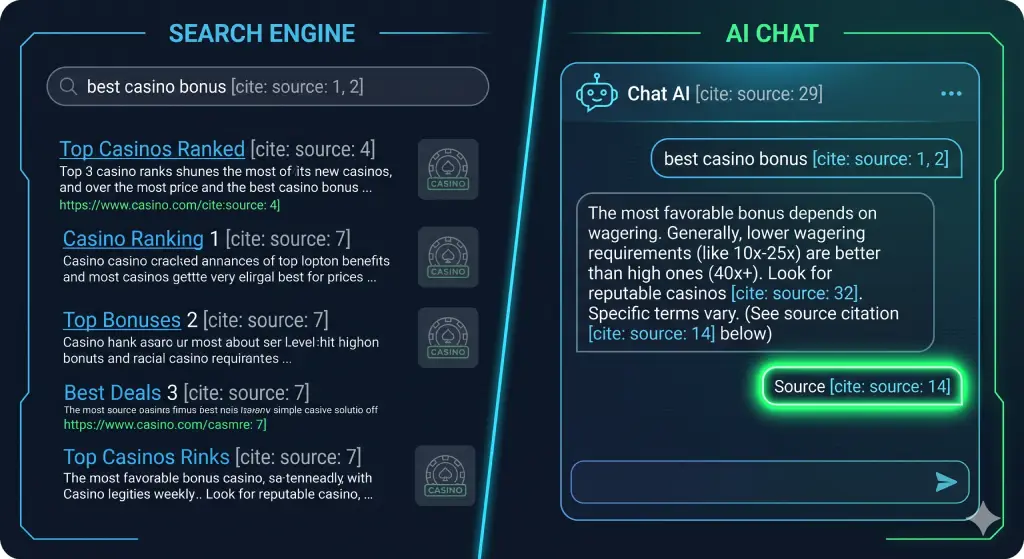
AI-powered platforms like Perplexity, ChatGPT, and Google’s AI Overviews are increasingly the first stop for player queries. They don’t return a list of results and ask the user to choose. They synthesise a single answer, often from two or three cited sources, and present it directly. No scrolling. No clicking. Just an answer.
AEO is the discipline of making your content the source that gets cited in that answer. Where SEO asks “how do I rank for this keyword?“, AEO asks “how do I become the authoritative answer to this question?” The goal, the structure, and the writing approach are all different.
I found that most iGaming site owners understand SEO well enough. Answer engine optimisation for iGaming, by contrast, is still being treated as optional or experimental. That gap is exactly where visibility is being lost right now.
Has SEO Stopped Working for iGaming Sites?
No, and any advice suggesting otherwise is fairly misleading. SEO remains the primary driver of direct traffic to your website. If search engines cannot crawl and index your site, AI won’t find your content. If your domain carries no authoritative backlinks, AI is unlikely to trust it even if it does find it.
What has changed is what SEO rewards. Keyword density is no longer the primary signal. Topical authority is. A site with 80 deeply accurate articles on live casino mechanics will outperform a site with 800 shallow articles covering every gambling topic imaginable. That shift has been underway for a while, and it isn’t unusual in competitive verticals.
SEO drives clicks. AEO for iGaming wins zero-click searches. In 2026, you need both, and I’ll explain what that looks like in practice.
What Is a Zero-Click Search, and Why Should iGaming Owners Pay Attention?
A zero-click search is one where the player gets their answer directly from an AI overview and never visits a website at all. No session recorded. No page view. No conversion opportunity in the traditional sense.
For iGaming site owners conditioned to measure everything in traffic and sessions, this sounds alarming. I’d argue it’s being misread, on three counts.
First, consider what actually happens when AI cites your site to answer a player’s question about wagering requirements or MGA licensing. That player reads your explanation and forms an opinion about your brand at zero cost to you. That’s a free brand impression at the exact moment of highest player intent, something no paid placement replicates in quite the same way.
Second, when AI consistently cites your content, it’s functioning as a third-party endorsement. The player isn’t choosing to trust you. An AI model they already trust is citing you as the authoritative source. That’s a different kind of credibility entirely.
Third, iGaming players rarely deposit on first touch. The player who gets a zero-click answer today is often the player who searches for your brand directly next week. Zero-click isn’t a lost conversion. It’s a top-of-funnel brand touchpoint that your GA4 won’t record but your long-term acquisition numbers will reflect.
Zero-click search in the casino space isn’t a traffic problem. It’s a brand authority opportunity most iGaming sites are leaving entirely unclaimed.
What Is the Difference Between AEO, SEO, and GEO for iGaming Sites?
These three are not competing strategies. They are complementary layers, each doing a different job. Here’s how they break down in practice for iGaming content:
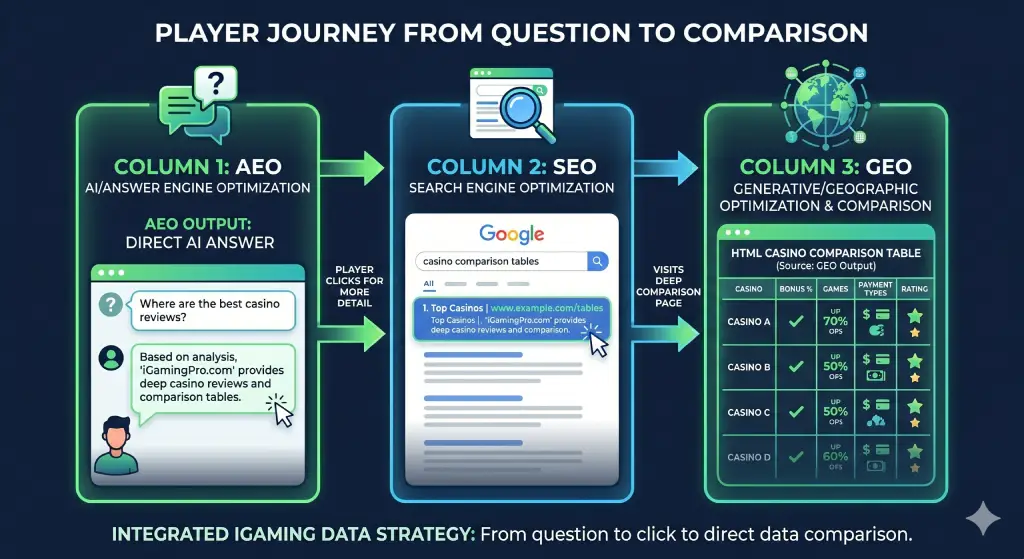
AEO (Answer Engine Optimisation) Targets AI-powered answer engines and voice assistants. Wins zero-click searches and AI citations. Requires direct answers within 40 to 60 words at the top of each section, question-format headings, and a structured FAQ targeting long-tail conversational queries.
SEO (Search Engine Optimisation) Targets traditional search engine rankings. Drives direct traffic through blue-link results. Requires topical authority, technical site health, authoritative backlinks, and long-form content with genuine E-E-A-T depth.
GEO (Generative Engine Optimisation) Targets AI models specifically when processing comparison and specification queries. Requires fact-dense structured data: HTML tables with RTP figures, licensing details, bonus term breakdowns, and KYC timeline comparisons. A relatively underused layer in iGaming content right now, and one of the more immediate opportunities available.
Each layer serves a different moment in the player’s information journey. AEO catches the question. SEO earns the click. GEO wins the comparison.
What Does the AEO SEO Hybrid Strategy Look Like on an iGaming Page?
The highest-performing iGaming content in 2026 combines all three layers on a single page. Writers and strategists using this AEO SEO hybrid approach are seeing a 3 to 5x increase in visibility, appearing in both traditional search results and AI overviews simultaneously.
It works like this:
The AEO layer (for answer engines)
- A direct 40 to 60-word answer to the page’s core question in the opening paragraph
- H2 and H3 headings phrased as real player questions
- Short, standalone paragraphs of three to four sentences maximum
- A dedicated FAQ section with long-tail conversational queries answered in full, self-contained sentences
The SEO layer (for human readers and search engines)
- A long-form narrative exceeding 1,000 words with expert analysis and genuine depth
- Case studies, original data, and accurate technical terminology (RTP, KYC, playthrough rates)
- Internal links to topically related pages and backlinks from authoritative external sources
The GEO layer (for AI comparison queries)
- HTML tables presenting hard specifications: RTP figures, bonus terms, licensing authority comparisons
- Numbered lists and structured steps wherever a process is being explained
- Fact-dense data structures AI can parse and reformat without losing accuracy
I think of it as the “Reader vs Data Feeder” model. The page serves two distinct audiences simultaneously. The human reader gets depth, narrative, and context. The AI model gets clean, extractable answer units, it can cite with confidence.
If you focus on AEO alone, you’ll accumulate citations but generate limited traffic. If you focus on SEO alone, you’ll rank, but increasingly beneath an AI overview that doesn’t cite you. The hybrid covers both.
AEO Readiness Checklist for iGaming Website Owners
Use this table as a quarterly audit across your highest-traffic pages.
| AEO Checkpoint | What to Check | Status |
|---|---|---|
| Answer-first opening | Does each major section open with a direct 40–60 word answer to the implied question? | |
| Question-format headings | Are H2 and H3 headings phrased as real player questions, not keyword clusters? | |
| Numerical specificity | Are RTP values, playthrough rates, and KYC timelines given as specific figures? | |
| Paragraph length | Are paragraphs kept to 3–4 sentences max for clean AI extraction? | |
| FAQ section present | Is there a dedicated FAQ targeting long-tail conversational queries with standalone answers? | |
| HTML tables for data | Are hard specs presented in HTML table format for GEO compatibility? | |
| Content freshness | Have bonus terms, RTP data, and licensing status been verified in the last 90 days? | |
| “Last updated” line | Does the page include a visible last-updated date? | |
| E-E-A-T signals present | Is there a verified author biography or credential reference on the page? | |
| Licensing accuracy | Are all referenced licences (MGA, UKGC, Curaçao) current and verifiable? | |
| Worked examples included | Do bonus pages include numerical examples (e.g., $100 bonus at 35x = $3,500 wagering)? | |
| Schema markup implemented | Is FAQ schema or HowTo schema applied on relevant pages? | |
| Hybrid structure in place | Does the page combine an AEO answer block, an SEO narrative, and GEO data tables? | |
| Priority pages identified | Have you identified the 10 pages most likely to be cited by answer engines? | |
| Competitor citation audit done | Have you checked which competitor pages are being cited in AI Overviews for your key queries? |
Expert’s Verdict
AEO for iGaming isn’t a replacement for SEO, and it isn’t optional for sites that want to stay visible through 2026 and beyond. It’s the third layer of a content strategy most site owners haven’t built yet.
The opportunity is solid. iGaming covers some of the most precisely queried, high-intent content categories on the internet. RTP figures, bonus mechanics, licensing status, KYC processes: these are exactly the answer types AI is built to surface. The AEO SEO hybrid model is more demanding to build and maintain. It’s also, fairly clearly, where the visibility is going.
Gambling should be entertaining, not a way to make money. If you or someone you know needs support, visit BeGambleAware.org.